

Appearance
Chapter 1: Architecture as Tradeoffs
General Track · Foundational · ~45 min read + exercise
Why this chapter exists
If you take one idea away from this entire course, make it this one: software architecture is the practice of choosing between options that are all flawed in different ways. Not finding the right answer. Choosing the least wrong combination of compromises for your particular situation.
This sounds almost too simple to be the foundation of a discipline. Most of us were trained to find correct answers. A failing test is wrong; a passing test is right. A function either returns the expected value or it doesn't. Years of that conditioning leave a lot of engineers expecting architecture to work the same way — that somewhere out there is the correct architecture for a given problem, and the job is to find it, the way you'd find the right algorithm for sorting a list.
Architecture doesn't work that way, and the sooner that clicks, the faster you start making good decisions.
Consider a concrete situation. Your team runs a Laravel application that's grown over four years. Page loads are getting slow because a handful of endpoints do a lot of database work on every request. Someone proposes adding a caching layer. Simple enough — except the moment you add a cache, you've signed up for a new problem: cache invalidation. Now data can be stale. A customer updates their profile and sees the old version for thirty seconds because the cache hasn't expired. So you make the cache smarter, invalidating specific keys on write — and now you've added code complexity and a new class of bugs where a missed invalidation serves wrong data indefinitely. You improved performance and you paid for it with consistency and complexity. There was no option on the table that gave you faster pages for free.
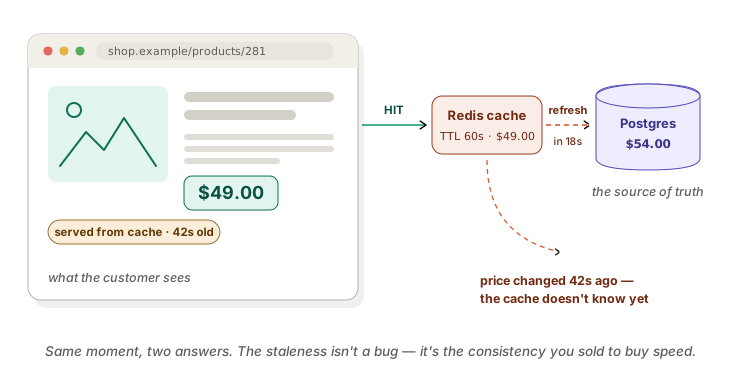
That's not a failure of design. That is design. Every meaningful architectural decision spends something to buy something else. The caching decision buys latency improvements with consistency guarantees and operational complexity. Whether that's a good trade depends entirely on your context — how stale can the data get before a customer is harmed? how much engineering time can you spend maintaining invalidation logic? — and those questions don't have universal answers. They have your answer, for this system, right now.
The same shape of problem shows up on the frontend, just wearing different clothes. Say you've got a Nuxt app with a product listing page, and you're deciding where the data fetch should live. You could fetch on the server during SSR, so the user gets a fully-rendered page on first paint — great for perceived performance and SEO. But now your server is doing the work on every request, your time-to-first-byte goes up, and you've coupled page rendering to the API being fast and available. Or you could render the shell immediately and fetch client-side after hydration — your server stays cheap and fast, but the user stares at a loading skeleton, and search crawlers may see an empty page. Or you split the difference: SSR the first screen, lazy-load the rest. That buys you a good first paint and a cheap server, paid for with more code, two data-fetching paths to maintain, and a more complicated mental model for the next developer who touches the component. There is no option that gives you fast first paint, a cheap server, good SEO, and simple code all at once. You're choosing which two or three you care about most for this page.
Notice that the Laravel example and the Nuxt example are the same decision underneath: you're spending one quality (consistency, or simplicity, or server cost) to buy another (latency, or SEO, or first-paint speed). The stacks differ; the reasoning is identical. That sameness is the whole point of learning to think in trade-offs rather than in framework recipes — once you see the underlying shape, it transfers everywhere.
"There are no best practices" is a stronger claim than it sounds
The authors of Software Architecture: The Hard Parts open their book with a deliberately provocative position: for the genuinely hard architectural problems, there are no best practices. Their reasoning is worth internalizing because it explains why this skill is hard to Google your way through.
When you hit a coding problem — how do I configure this tool, why is this query slow, what's the syntax for this — you can almost always find someone who has hit the exact same problem and written it up. Stack Overflow exists because coding problems recur across contexts. The same bug shows up in thousands of codebases.
Architectural problems are different because they're entangled with the specific circumstances of your organization: your team's size and skills, your existing systems, your compliance requirements, your deadlines, your budget, your appetite for operational risk. The odds that someone has faced exactly your combination of constraints and blogged about it are low. As the Hard Parts authors put it, for an architect, every problem is something close to a snowflake. The work isn't recalling a known answer. It's reasoning through a novel set of trade-offs to find the least-bad path.
This is also why "we should use microservices" or "we should always decouple" are not architectural decisions — they're slogans. An architectural decision sounds like: "We're going to split the billing service out from the monolith, accepting the added operational overhead and network latency, because billing has a different release cadence and compliance profile than the rest of the app, and the team boundaries already line up that way." That sentence names what's being bought (independent deployment, isolation) and what's being paid (overhead, latency). A slogan names neither.
The "least worst" mindset
The Hard Parts authors offer a piece of tongue-in-cheek advice that's worth taking seriously: don't try to find the best design, strive for the least worst collection of trade-offs. The phrasing is deliberately humbling. "Best" implies you maximized everything — fastest and simplest and cheapest and most reliable. That design doesn't exist, because those properties fight each other. What you can actually produce is a design where no single quality is as good as it could be in isolation, but the balance across all of them serves the project well.
This reframing has a practical payoff: it changes what a good architectural conversation sounds like. When the goal is "the best design," conversations turn into people advocating for their preferred solution and treating objections as attacks. When the goal is "the least worst set of trade-offs," the conversation becomes a shared investigation: what are we giving up with each option, and which sacrifices can we actually live with? The second kind of conversation is enormously more productive, and a big part of becoming a senior engineer is learning to steer rooms toward it.
What this chapter covers
The rest of this chapter builds the vocabulary and mental tools for thinking in trade-offs:
- Quality attributes (the "-ilities") — the measurable properties of a system that you're actually trading between.
- How attributes trade against each other — the specific tensions that come up again and again, so you recognize them in the wild.
- Constraints — the boundaries of your design space, which often matter more than the attributes themselves.
- Architecture Decision Records (ADRs) — how to capture a decision and its trade-offs so the reasoning survives.
By the end you'll do a hands-on exercise applying the trade-off lens to a real decision and produce a short ADR you can actually use at work.
Let's start with the thing you're trading: quality attributes.
Quality attributes: the things you're actually trading
When you build a feature, you're usually focused on what the system does — a customer can register, a ticket gets assigned, a report renders. Those are functional requirements, and they're what product managers write tickets about. They matter, obviously, but they're not what architecture is mostly concerned with.
Architecture is mostly concerned with how the system is, independent of what it does. Is it fast? Does it stay up? Can a new engineer change it without fear? Can it handle ten times the traffic? Will it survive a database outage? These are quality attributes — sometimes called non-functional requirements, sometimes "the -ilities" because so many of them end in those letters. They're the properties you trade between, and they're the vocabulary you need before you can have a precise conversation about a design.
Here's the distinction made concrete. "A customer can update their email address" is functional — it describes a behavior. "Updating an email address completes in under 200 milliseconds for 99% of requests, even during peak load, and the change is reflected everywhere within five seconds" is a stack of quality attributes: performance, scalability, and consistency, each with a number attached. Two systems can both satisfy the functional requirement and be wildly different architectures because they made different quality-attribute choices.
The attributes you'll actually reason about
There are long catalogs of quality attributes — the ISO/IEC 25010 standard lists dozens — but in day-to-day work a smaller set comes up constantly. Here are the ones worth knowing cold. The third column is the one to internalize: knowing what an attribute feels like when it's missing is how you recognize which one you're short on.
| Attribute | What it is | What it feels like when it's missing |
|---|---|---|
| Performance | How fast the system responds to one request (latency / throughput) | Spinners, sluggish pages, a report that takes a coffee break |
| Scalability | Holding up as load grows by adding resources | Fast for one user, falls over at ten thousand |
| Availability | Proportion of time the system is up, measured in "nines" — "five-nines" means 99.999% uptime, roughly 5 minutes of downtime a year | Outages; the site is simply down when someone needs it |
| Reliability | Behaving correctly and not losing data, especially under failure | Wrong answers, silently dropped writes — worse than being down |
| Security | Resisting unauthorized access and protecting data | A breach; the adversarial attribute where "fine for now" rots fast |
| Maintainability | How safely a human can understand and change the system | Every change is slow and scary; this is technical debt accruing |
| Testability | How easily you can verify correct behavior | Can't write a test without standing up half the world |
| Deployability | How easily and often you can ship to production | Two-hour coordinated releases every two weeks |
| Observability | Understanding what production is doing from the outside | 2 a.m., something's broken, and you have no idea why |
| Evolvability | Absorbing changes in direction, not just code | The system fights every pivot the business wants to make |
| Cost | What the system takes to build and to run (infrastructure, licenses, engineering time) | A design that's technically correct and quietly unaffordable |
Five of these deserve a note beyond the table.
Performance vs. scalability trip people up because they sound alike. Performance is "how fast for one"; scalability is "does it stay acceptable as load grows." The fixes differ, so the distinction matters: a system can ace one and fail the other.
Reliability vs. availability are also distinct. Availability is whether the system responds; reliability is whether it responds correctly. A system that's up but silently dropping writes is available and unreliable — and that's often the more dangerous failure, because nobody notices until the data's already gone. Reliability gets its own chapter later, because the patterns that produce it (timeouts, retries, idempotency, circuit breakers) are a toolkit in their own right.
Evolvability (sometimes called agility) is special because, as the Fundamentals authors point out, it isn't directly measurable on its own. It's a composite — it emerges from attributes you can measure: deployability, testability, maintainability, modularity. When someone says "we need the system to be more agile," the useful move is to decompose that into the measurable attributes underneath, because you can't write a test for "agility" but you can write one for "no module has a circular dependency."
Cost is the attribute engineers most often leave off the list, and it's the one that quietly governs all the others. You can frequently buy more performance, more reliability, or more availability — bigger machines, more replicas, more redundancy — with money, which means cost is the attribute you're trading them against. A design that ignores it can be flawless on every other axis and still be the wrong answer, because "correct and unaffordable" is just a slower way to be wrong. Whenever you push another attribute up, it's worth asking what it costs to build and to run, so the trade is made on purpose rather than discovered on the invoice.
Maintainability is the attribute this course works hardest to protect, and it's notoriously hard to put a number on. A sharp operational test comes from John Ousterhout's A Philosophy of Software Design: the thing that erodes maintainability is complexity, and complexity has just two sources — dependencies (you can't understand or change one piece of the system without understanding or changing another) and obscurity (the information you need to make a change isn't where you'd naturally look for it). It's a code-level book, but the test scales straight up to architecture: a service boundary that forces three teams to coordinate every release is a dependency; a config flag whose blast radius nobody can predict is obscurity. When a design simply feels hard to maintain, ask which of those two it's adding — that's a faster, more concrete diagnosis than arguing about maintainability in the abstract, and it's a lens this course returns to in later chapters.
The evolvability point — that a vague attribute hides measurable ones underneath — generalizes into a rule worth holding onto: if you can't measure an attribute, you probably haven't defined it precisely enough. "The site should be fast" is a wish, not a requirement. "Search results return in under 300ms at the 95th percentile under 1,000 concurrent users" is a requirement, because a test or monitor can give an objective yes-or-no. Vague attributes are usually composite attributes in disguise, and making them measurable forces you to understand what you actually want.
You cannot optimize for all of them
Here's the part that makes quality attributes architectural rather than just a checklist: they compete. Pushing one up very often pushes another down. This isn't a flaw in how we build software; it's closer to a law of the medium. A system maximally optimized for performance looks different from one maximized for maintainability, which looks different from one maximized for security. You cannot have the maximum of all three simultaneously, any more than you can have a car that is simultaneously the fastest, the cheapest, and the most fuel-efficient. Engineering is the art of picking the right compromise, and that's true whether the engineering is mechanical or in software.
This is why the catalog above isn't a to-do list where you tick every box. It's a menu of things you'll be ranking. The senior-engineer skill is figuring out, for a given system and moment, which two or three attributes matter most — and being honest that elevating them means accepting weaker positions on the others. A startup racing to find product-market fit should almost certainly rank deployability and evolvability above scalability, because their problem is "will anyone want this," not "can we serve a billion users" — and building for the billion users they don't have yet costs them the agility they desperately need. A bank's core ledger ranks reliability and security above almost everything, including deployability, because the cost of a wrong answer dwarfs the cost of shipping slowly.
There's a trap the Hard Parts authors name that's worth flagging here, because it's the most common way trade-off analysis goes wrong in practice: evaluating an attribute out of context. It's tempting to argue "approach A has better throughput than approach B" as though that settles it. But throughput only matters if throughput is something this system actually needs more of. An architecture decision isn't "which option is better in the abstract" — it's "which option is better given what this system needs to be good at." The same option can be the right call for one system and the wrong call for its neighbor, and the only thing that changed is the context. Keep dragging every comparison back to "better for what, here."
How exactly do these attributes pull against each other? That's the heart of the matter, and it's where we go next — the specific, recurring tensions you'll see over and over, in both your Laravel services and your Vue frontends.
The recurring tensions
The competition between quality attributes isn't random. A handful of specific tensions show up again and again, across stacks and across decades, and once you can name them you start spotting them before they bite. This section walks the ones you'll meet most often. For each, the underlying tension is stack-agnostic — but to make it concrete, I'll ground most of them in both a Laravel/backend framing and a Vue/Node framing, because the same tension wears different clothes depending on where in the system you're standing.

A note before we start: these tensions are not problems to be solved. They're forces to be balanced. You will never make performance and maintainability stop pulling against each other. The goal is to know where the rope currently sits and to move it deliberately rather than by accident.
Here's the set at a glance, before we walk each one:
| Tension | You raise… | You pay with… | Where you'll meet it |
|---|---|---|---|
| Performance vs. maintainability | Speed | Readability, safe change | Hot paths, optimized components |
| Performance/scalability vs. consistency | Throughput, latency | Fresh, agreed-on data | Caches, replicas, optimistic UI |
| Security vs. usability | Protection | Friction-free experience | Auth, sessions, permissions |
| Time-to-market vs. everything | Shipping now | Maintainability, scale, polish | Every deadline |
| Simplicity vs. flexibility | Understandability | Adaptability to future change | Abstractions, config, plugin points |
Performance vs. maintainability
This is the most pervasive tension in all of software, and the one most likely to erode silently. The fastest code is frequently the least readable: hand-tuned, inlined, caching intermediate results, exploiting framework internals, trading clear structure for speed. The most maintainable code is frequently a little slower: layered, indirected, abstracted so a human can reason about each piece in isolation.
In a Laravel service, you feel this the moment an endpoint gets slow. The clean version uses Eloquent models, relationships, and accessors — readable, expressive, easy for the next developer to follow. Then profiling reveals the N+1 query problem, or that loading full models to read two columns is wasteful, and someone rewrites the hot path as a raw query builder statement or even raw SQL. It's faster. It's also now a chunk of hand-written SQL that doesn't go through your models, bypasses your accessors and casts, and will silently break if someone renames a column. You bought latency with maintainability. Sometimes that's exactly right — a reporting query hit thousands of times an hour earns its optimization. Sometimes it's premature, and you've uglied up code that ran fine, paying maintainability for performance nobody needed.
On the Vue side, the same tension appears as you optimize a component that re-renders too much. The clean version is straightforward reactive bindings and computed properties. The fast version starts reaching for manual memoization, v-once, carefully placed shallowRefs, or hand-managed watchers that update only the precise thing that changed. Each optimization makes the component faster and makes it harder for the next person to understand why it's shaped the way it is — and therefore easier to break when they "simplify" it. Same trade, different framework.
The discipline here is the old Knuth caution against premature optimization, stated in trade-off terms: don't pay maintainability for performance until you have evidence the performance matters. Profile first. Spend the maintainability only where a measurement says the speed is worth it.
Performance/scalability vs. consistency
We met this one in the opening with caching, and it deserves a proper look because it's the tension at the center of most distributed-system pain. Strong consistency — everyone sees the same data at the same time — is easy when there's one database and one copy of the truth. The moment you want to go faster or handle more load, you start making copies: caches, read replicas, denormalized views, data duplicated across services. Every copy is a place the truth can be stale. You're trading consistency for performance and scalability.
The key insight that keeps this tension manageable: consistency isn't one global setting. Different data tolerates different amounts of staleness, and a good design places each piece of data where it belongs on the spectrum rather than applying one rule everywhere.

In Laravel, the progression is almost a rite of passage. First it's a cache in front of expensive reads — now data can be stale until the cache expires or is invalidated. Then it's a read replica to take load off the primary — now there's replication lag, and a user can update something, immediately reload, and see the old value because the read hit a replica that hadn't caught up yet. Neither is a bug; both are the consistency you sold to buy throughput. The architectural question is never "how do I get both" — you can't, fully — it's "how much staleness can each piece of data tolerate." A product's view-count can be wildly stale and nobody's harmed. A user's account balance cannot. Same system, different consistency requirements per piece of data, and a good design treats them differently rather than applying one rule everywhere.
On the frontend, this tension lives in client-side state and optimistic updates. The fully-consistent approach: every action hits the server, you wait for the response, then you update the UI to reflect confirmed truth. It's correct and it feels sluggish. The fast approach: optimistic updates — you update the Pinia store immediately, assume the server will agree, and reconcile later if it doesn't. The UI feels instant. But now your client state and server state can diverge, and you've signed up for the genuinely hard work of reconciliation: what happens when the optimistic update was wrong? You traded consistency for perceived performance, and you're paying it back in rollback logic and edge cases. Kleppmann's Designing Data-Intensive Applications spends a good portion of the book on exactly this tension at the data layer; it's worth knowing that the thing you're wrestling with in a Pinia store is the same problem distributed databases wrestle with, just smaller.
Security vs. usability (and performance)
Security trades against nearly everything, which is part of what makes it hard to get right — every security control is friction somewhere. The most secure system is unusable: no access at all. Every step you take toward usability — staying logged in, fewer permission prompts, faster flows — is, in some measure, a step away from maximum security. The job is calibrating the trade to the actual threat, not maximizing either end.
Concretely: requiring re-authentication before every sensitive action is more secure and more annoying. Long-lived sessions are more usable and a bigger window for a stolen token to be abused. Multi-factor auth meaningfully raises security and adds a step every user feels. Rate limiting protects you from abuse and occasionally frustrates a legitimate power user. On the performance axis specifically, encryption, hashing work factors, and per-request authorization checks all cost cycles — usually worth it, but not free. None of these has a universally correct setting. A banking app and a recipe-sharing app should land in very different places, because their threat models and the cost of a breach are different by orders of magnitude. Setting both to the same level means one is over-secured into uselessness or the other is under-secured into danger.
Security is a design activity, not just an ops concern
It's tempting to treat security as something you bolt on downstream — a penetration test before launch, a WAF in front of the app, a checklist the security team owns. Those matter, but they arrive too late to change the shape of the system, and shape is where the expensive vulnerabilities live. Security is most effective as a design activity: something you do while you're still drawing boxes and arrows, when changing the architecture is cheap.
The core move is threat modeling — reasoning about your system adversarially, before it's built. You map the system's trust boundaries (where data or control crosses from something you trust into something you don't — the browser, a third-party API, another team's service) and then ask, at each boundary, what could an attacker do here? Who are the plausible attackers, what are they after, and what's the attack surface they'd aim at? Thinking that way early surfaces design-level fixes — a boundary that shouldn't exist, data that shouldn't be collected at all, a trust assumption that's actually unwarranted — that a late security review can only paper over. This pairs directly with the trust-boundary thinking the rest of this course leans on: the same boundaries that shape your data and communication choices are the ones an attacker probes, so reasoning about them once, adversarially, pays off on both fronts.
(Flagged: threat-modeling methodology — trust boundaries, attacker modeling, attack-surface analysis — comes from the security literature rather than the six source books; the trade-off framing around it is the chapter's.)
Time-to-market vs. nearly everything
This is the trade-off that's easiest to forget is a trade-off, because it doesn't feel like architecture — it feels like pressure. But every "we'll do it properly later" is an explicit decision to trade maintainability, sometimes reliability, sometimes scalability, in exchange for speed right now. And sometimes that's the correct call. Shipping a slightly-wrong thing this week can be worth more than a perfect thing next quarter, if this week is when you learn whether anyone wants it at all.
The danger isn't making this trade. It's making it invisibly — taking on the debt without naming it, so it never gets repaid because nobody wrote down that it was borrowed. The architect's move isn't to refuse the trade; it's to make it explicit. "We're shipping the synchronous version now and accepting that it won't scale past a few hundred users, with a known plan to move it to a queue when we approach that ceiling." Now it's a decision with a tripwire, not a silent landmine.
The counterweight to debt taken on under deadline is paying a little of it down continuously, rather than in a someday-rewrite that never arrives. Ousterhout's rule of thumb in A Philosophy of Software Design is to spend roughly ten to twenty percent of your time on design investment — small, ongoing cleanups as you work — arguing that it pays for itself within months and compounds after that. The exact number isn't sacred, but its shape is: continuous small investment beats both the heroic up-front design (you can't predict enough yet) and the deferred someday-cleanup (it doesn't happen). Which is the perfect segue, because making trade-offs explicit and durable is exactly what the rest of this chapter is about.
A tension you'll feel but might not name: simplicity vs. flexibility
One more, because it underlies a huge fraction of over-engineering. A simple design does exactly what's needed now and is easy to understand. A flexible design anticipates change — configuration over hardcoding, abstraction layers, plugin points, generalized interfaces — and is harder to understand because it carries machinery for futures that haven't arrived. Every premature abstraction is this trade made badly: paying comprehensibility now to buy flexibility you're guessing you'll need. Sometimes the guess is right and you look prescient. More often the anticipated change never comes, or comes in a shape your abstraction didn't predict, and you've paid for flexibility you never used. "Build for the requirements you have, not the ones you imagine" is this trade-off's version of the premature-optimization warning — and it's worth being just as suspicious of premature flexibility as of premature optimization, because the former hides better. It looks like good engineering.
These tensions aren't an exhaustive list — you'll meet others — but they're the ones frequent enough that naming them gives you a real head start. The skill that turns this knowledge into judgment is noticing which tension you're standing in, then asking what your specific context wants from it. And that judgment is only as good as your understanding of the boundaries you're operating inside — which is the next piece: constraints.
Constraints: the edges of the design space
So far we've talked as though you get to freely rank quality attributes and pick where each tension settles. In reality, you almost never start with a blank page. You start inside a box defined by constraints — facts about your situation that you don't get to choose, that wall off large parts of the design space before you've made a single decision. And here's the thing junior engineers consistently underestimate: the constraints often determine the answer more than the technical merits do. A technically superior design that violates a hard constraint isn't superior. It's disqualified.

It helps to sort constraints into a few kinds, because they behave differently and you discover them in different ways.
Technical constraints are the ones engineers think of first. You're on a specific cloud provider. You have a Postgres database the rest of the company standardized on and won't replatform for your feature. Your frontend has to run on devices going back a few years, so you can't assume the latest browser APIs. The existing system is a Laravel monolith, and "rewrite it in Go" is not on the table this quarter no matter how appealing. These constraints are usually the easiest to see, though teams still routinely design as if they weren't there and then act surprised when reality pushes back.
Organizational constraints are about people and structure, and they're more powerful than they look. How many engineers do you have, and what do they know? A microservices architecture that needs a dozen services independently operated is a fantasy for a four-person team — not because it's technically wrong but because there aren't enough humans to run it. This connects to Conway's Law, an observation from 1967 (published 1968) that has aged unnervingly well: organizations design systems that mirror their own communication structure. If you have three teams, you will tend to produce three major components whether or not three is the right number, because the seams in software follow the seams between the people building it. The mature version of this insight, sometimes called the Inverse Conway Maneuver, is to deliberately shape teams to produce the architecture you want — but even if you're not doing that, you ignore Conway's Law at your peril. A design that cuts across your team boundaries will be fought by the org chart, and the org chart usually wins.
Financial constraints are the budget — both the money to build and the money to run. The five-nines availability we discussed earlier isn't just technically demanding; it's expensive in redundant infrastructure and the engineering time to operate it. "We can't afford that level of reliability" is a completely legitimate architectural input, and pretending otherwise produces designs that look great in a doc and never get funded.
Regulatory and compliance constraints are hard walls, not preferences. If you handle health data under HIPAA, payment data under PCI-DSS, or EU personal data under GDPR, those regimes dictate where data can live, how it must be protected, who can access it, and how long you keep it. These aren't attributes you trade against performance — you don't get to decide that a little less GDPR compliance is worth a latency win. They're boundaries you design within. (This is also why "just cache the user's data at the edge for speed" can be a non-starter regardless of how much it'd help performance — data residency rules may forbid that copy from existing where the edge node is.)
Temporal constraints are deadlines, and they're a constraint as real as any other even though they feel like pressure rather than fact. If the trade show is in eight weeks, "the design that would take twelve weeks" is not available, full stop. Time collapses the design space the same way a budget does, and the time-to-market tension from the previous section is what playing inside this constraint feels like.
Constraints are clarifying, not just limiting
It's tempting to experience constraints purely as walls hemming you in. But there's a reframe that working architects lean on: constraints make decisions tractable. An infinite design space is paralyzing — if anything is possible, where do you even start? Constraints prune the tree. The moment you accept "Postgres, this team of five, ship in two months, GDPR applies," whole branches of possibility fall away and you're left with a manageable set of real options. Some of the cleanest architectural thinking happens precisely because the constraints were tight enough to force focus. A blank check and infinite time produce worse systems more often than you'd expect, because nothing forces the hard prioritization that makes a design coherent.
This is why one of the most valuable things you can do early in any design is surface the constraints explicitly before debating solutions. Half of the circular architecture arguments you'll sit through are two smart people advocating for designs that optimize different attributes — and the argument can't resolve because nobody has established which constraints are actually binding. The instant someone says "wait, this has to ship before the December compliance deadline and we can't add infra spend this fiscal year," the debate collapses to a much smaller, answerable question. Naming the box is often the highest-leverage move in the whole conversation.
A practical habit, then: at the start of a design discussion, write down the constraints you know of and explicitly mark which are hard (genuinely non-negotiable — the regulation, the deadline tied to a contract) versus soft (strong preferences that could bend under enough pressure — "we'd rather not add another datastore"). Teams routinely treat soft constraints as hard ("we can't use a new database") and burn enormous effort working around walls that were actually just doors nobody tried. The opposite error — treating a hard constraint as soft and designing through it — is the one that gets discovered late and expensively, usually in a compliance review or a budget meeting after the code is written.
You now have the full kit for reasoning about a decision: the attributes you're trading, the tensions between them, and the constraints that bound the whole exercise. The last thing you need is a way to capture a decision once you've made it — so the reasoning survives contact with the future, and the next engineer (possibly you, eighteen months from now, having forgotten everything) understands not just what was decided but why. That's what Architecture Decision Records are for.
Capturing the decision: ADRs
Here's a scene every engineer eventually lives through. You're deep in a codebase and you find something that looks wrong — a service split that seems arbitrary, a queue where a direct call would obviously be simpler, a denormalized table that's clearly going to cause consistency headaches. Your instinct is "whoever did this didn't know what they were doing." So you "fix" it. Three weeks later you discover the painful reason it was built that way — the constraint you didn't know about, the failure mode they'd already hit — and you've reintroduced a bug someone solved a year ago.
The decision was made well. What was lost was the reasoning. The code records what was built; it does not record what was considered and rejected, or what constraint forced the shape, or which trade-off was being deliberately accepted. That knowledge lived in someone's head and left when they changed teams.
An Architecture Decision Record is the cheap, durable fix for this. It's a short document — genuinely short, one to two pages — that captures a single significant architectural decision: what you decided, why, what else you considered, and what it costs you. ADRs were popularized by Michael Nygard in a 2011 blog post, and they've become close to an industry-standard practice precisely because the cost is tiny and the payoff compounds. A decision recorded today saves an afternoon of archaeology for someone (maybe you) every time the question resurfaces.
What goes in one
The format is deliberately minimal — the point is that writing one should be fast enough that you actually do it. The classic Nygard structure has just a few sections:
Title — a short noun phrase naming the decision. "Use read replicas for reporting queries," not "Database stuff."
Status — proposed, accepted, superseded, deprecated. Decisions evolve; an ADR that's been superseded points to the one that replaced it, so the record becomes a history of how the architecture's thinking changed, not just a snapshot.
Context — the situation that forced a decision. What's the problem? What constraints are binding? What quality attributes are in tension? This is the most valuable section and the one people skimp on. The context is what your future reader has lost and most needs back. Write it as if explaining to a competent engineer who knows the system but wasn't in the room.
Decision — what you chose, stated plainly and in the active voice. "We will route all reporting queries to a dedicated read replica."
Consequences — what results, both good and bad. This is the section that separates an honest ADR from a sales pitch. You must write down what the decision costs, not just what it buys, because the whole premise of this chapter is that every decision costs something. An ADR that lists only benefits is hiding the trade-off, which means the next person can't evaluate whether the trade still holds when circumstances change.
That last point is worth dwelling on, because it's where the whole chapter lands. Everything we've built — quality attributes, tensions, constraints — exists to be named in the consequences section. A good ADR says, in effect: "We prioritized these attributes, accepted weaker positions on those, within these constraints, and here's specifically what we're paying for it." If you can write that sentence honestly, you understand your decision. If you can't, you haven't finished making it.
A worked example
Here's a complete ADR for the caching decision from the opening of this chapter, written the way you'd actually commit it to a repo. Notice it's short, it names the trade-off explicitly, and the consequences section is honest about the downside.
markdown
# ADR 014: Cache product detail responses in Redis

## Status
Accepted

## Context
The product detail endpoint (`GET /products/{id}`) performs several
joins and an inventory lookup on every request. Under normal load it
responds in ~400ms; under peak (campaign launches) p95 latency exceeds
2s and the database CPU saturates, which degrades unrelated endpoints
sharing the primary.

Constraints:
- Hard: we cannot add database capacity this quarter (budget frozen).
- Hard: product pricing must be accurate — stale prices are a
  compliance and customer-trust problem.
- Soft: we'd prefer not to introduce a new datastore, but Redis is
  already in our stack for sessions.

The tension is performance/scalability vs. consistency: caching
relieves the database but introduces staleness.

## Decision
We will cache the assembled product detail response in Redis with a
60-second TTL. Price fields will be excluded from the cached payload
and fetched live on each request; only the slow-changing descriptive
fields (name, description, specs, images) are cached.

## Consequences
Positive:
- Removes the expensive joins from the hot path for ~95% of reads.
- Bounded staleness (60s) on descriptive fields, which the business
  has confirmed is acceptable.
- Reuses existing Redis infra — no new datastore to operate.

Negative / costs:
- Added code complexity: two data paths (cached descriptive fields +
  live price) must be assembled per request and kept in sync.
- A bug in the price-exclusion logic could serve a cached price —
  we mitigate with a contract test asserting price is never cached.
- Cache stampede risk on TTL expiry under peak load; we accept this
  for now and will add request coalescing if it materializes.
Read the consequences section again and notice what it's doing: it's the trade-off analysis from this entire chapter, compressed into a few honest bullet points. It names what was bought (latency, database relief), what was paid (complexity, a new failure mode), and even where a future trade-off was deferred ("we accept this for now"). Anyone who reads this in a year understands not just the cache, but the reasoning — and can tell whether the reasoning still holds.
Where ADRs live and how to use them
Keep ADRs in the repo, usually in a docs/adr/ directory, numbered sequentially (0001-..., 0002-...). The reason is that they should version alongside the code they describe — when you check out an old branch, you get the decisions that were current then. They're plain Markdown, they show up in pull requests, and reviewers can comment on the reasoning before the decision is locked in. Some teams make a new significant PR include an ADR as part of the change, which turns architectural decision-making into a reviewable, social act rather than something that happens silently in one person's head.
A few practical notes that save pain. Don't write an ADR for every decision — only the significant ones, the ones where someone might later wonder "why on earth is it like this?" Choosing a variable name doesn't need an ADR; choosing to split a service does. Don't edit an accepted ADR to change the decision — instead, write a new one with status "accepted" and mark the old one "superseded by ADR 023." The trail of superseded decisions is itself valuable; it shows how the architecture learned. And write the ADR when you make the decision, not months later — the context is freshest then, and a decision recorded after the fact tends to be a rationalization rather than an honest account of what you actually weighed.
With ADRs, the loop closes. You reason about a decision using quality attributes, tensions, and constraints — and then you capture that reasoning in a form that survives, so the next person inherits your thinking instead of having to reconstruct it. That habit, practiced consistently, is a surprising amount of what separates teams whose architecture stays coherent over years from teams whose systems slowly become mysteries even to the people maintaining them.
The remaining piece is to put this into your hands — so the last part of the chapter is a hands-on exercise where you do exactly this reasoning on a real decision and produce an ADR of your own.
Practice
Reading about trade-offs doesn't build the skill. Doing the analysis on something real does. The exercises below move from quick reflection to a deliverable you can actually use at work. Budget about two hours total.
Exercise 1: Map a tension you live with (20 min)
Pick a system you work on regularly. Identify one architectural decision in it that you didn't make but live with daily — a caching layer, a service boundary, a data duplication, a sync-vs-async choice. Write two or three sentences answering: which quality attributes does this decision prioritize, and which did it sacrifice to get them? Don't research it; just reason from what you know. The goal is to practice seeing a decision as a trade rather than as a fact of the landscape.
Exercise 2: Generate and critique alternatives (45 min)
This is the core exercise. Take a decision you're genuinely facing or recently faced, and force yourself past the first solution that came to mind — the real skill is holding several options side by side and seeing what each trades.
Write down the decision with honest context: the problem, the constraints you're under, the attributes you care about. Then generate two or three alternative approaches, and for each, lay out what quality attributes it optimizes and what it sacrifices. The point isn't to pick a winner yet; it's to make the trade-offs visible so the choice is informed rather than reflexive.
This is a good place to use an AI assistant if you have one handy — it's a fast way to surface alternatives you wouldn't have thought of, and to get a first draft of each option's trade-offs. But if you do, treat its output as raw material to interrogate, not an answer to accept. It doesn't know your binding constraints unless you told it, doesn't know your team's real capacity, and doesn't know the history that rules options in or out. Find where its suggestions are wrong for your situation: where it proposed something a constraint forbids, where it treated an attribute as important that your context doesn't actually need (the out-of-context trap), where it was generically reasonable but specifically naive. The judgment stays yours; the tool just widens the set of options you're judging.
Whether you brainstorm solo, with a colleague, or with an assistant, the deliverable of this step is the same: a short comparison — half a page — of the alternatives and what each one costs.
Exercise 3: Write the ADR (45 min)
Take the decision from Exercise 2 and write a real ADR for it, using the format from the previous section: title, status, context, decision, consequences. Hold yourself to the honesty standard — the consequences section must name what the decision costs, not just what it buys. If you can't articulate the cost, that's a signal you haven't finished thinking it through; go back to the analysis.
Keep it to a page. The discipline of compression is part of the exercise — an ADR that runs to five pages won't get read, and the act of cutting forces you to find what actually matters.
Deliverable
A one-page ADR for a real (or realistic) architectural decision, including all five sections, with a consequences section that honestly names the trade-off. Submit it through your track's review channel; a reviewer will read it in about fifteen minutes and respond on one question: is the trade-off named honestly and completely, or does the ADR hide a cost?
Check yourself
Before you consider this chapter done, you should be able to:
- Explain, without notes, why "we should use microservices" is a slogan rather than an architectural decision.
- Name at least six quality attributes and, for any two, describe a realistic situation where improving one degrades the other.
- Take a vague requirement like "the system should be fast" and rewrite it as a measurable one.
- Distinguish a hard constraint from a soft one in a system you work on, and give an example of each.
- Write an ADR whose consequences section a skeptical colleague would call honest.
If any of those feel shaky, the fix is usually rereading the relevant section and doing the exercise on a second example — the concepts cement through application, not rereading.
What a strong answer demonstrates: a strong self-assessment doesn't just list quality attributes — it shows you naming a specific tension and the context that decides where it should settle, then carrying that honesty into an ADR whose consequences section a skeptic couldn't accuse of hiding a cost. The tell of real understanding is that you can say what each decision is bad at, not just good at, and tie that to a binding constraint rather than a generic preference.
Going deeper (optional)
This chapter distilled ideas from several sources. If a topic grabbed you and you want the long form, these are where to go:
- Fundamentals of Software Architecture (Richards & Ford) — Chapters 4 and 5 are the definitive treatment of architecture characteristics and how to identify them for a given system. The whole "-ilities" framing in this chapter compresses their work.
- Software Architecture: The Hard Parts (Ford, Richards, Sadalage, Dehghani) — Chapter 1 for the "least worst trade-offs" philosophy and the out-of-context trap; the book as a whole is an extended masterclass in trade-off analysis on genuinely hard distributed-systems decisions. We return to it heavily in the synthesis and capstone chapters.
- Michael Nygard's original 2011 post "Documenting Architecture Decisions" — the source of the ADR format, a ten-minute read, still the clearest statement of the idea.
- A Philosophy of Software Design (John Ousterhout) — a short, opinionated book one altitude below this course, at the class-and-method scale. Its definition of complexity as dependencies + obscurity (the lens introduced above) and its strategic-vs-tactical / continuous-investment framing are the code-level companion to this chapter's architecture-level trade-off thinking. The consolidated primary-sources note explains where it fits relative to the course's canonical sources.
Primary sources (the foundational texts beneath the trade-off mindset, if you want the theory on-ramp):
- Frederick P. Brooks, "No Silver Bullet—Essence and Accident in Software Engineering" (IEEE Computer, April 1987) — the classic argument that software's essential complexity can't be engineered away, only managed and traded against. It's the intellectual root of "there is no free lunch," a few pages long, and worth reading once in your career.
- David L. Parnas, "On the Criteria To Be Used in Decomposing Systems into Modules" (Communications of the ACM, December 1972) — the paper that first framed information hiding and module boundaries as deliberate design choices with consequences, which is where "every decision spends something" begins.
- Melvin E. Conway, "How Do Committees Invent?" (Datamation, April 1968) — the original statement of what became Conway's Law, the organizational constraint this chapter leans on.
None of this is required to continue. The chapter stands on its own; the sources are there if you want the depth behind the distillation.
Key takeaways
- Architecture is choosing the least worst combination of trade-offs for your specific context — not finding a universally correct design.
- Quality attributes (the "-ilities") are the measurable properties you trade between; if you can't measure one, you haven't defined it precisely enough.
- Attributes compete — performance vs. maintainability, performance/scalability vs. consistency, security vs. usability, and others recur constantly. Naming the tension you're in is half the work.
- Constraints (technical, organizational, financial, regulatory, temporal) bound the design space and often determine the answer more than technical merit does. Separate hard constraints from soft ones explicitly.
- ADRs capture a decision and its reasoning so it survives. The consequences section, written honestly, is your trade-off analysis made durable.
Next chapter: Architectural Styles — we take the trade-off lens you just built and point it at the big structural choices: layered architectures, modular monoliths, microservices, and event-driven systems. Each is a different bundle of the trade-offs from this chapter, and choosing among them is this chapter's reasoning applied at the largest scale.